Showing posts with label Tetra Tech. Show all posts

Tuesday, June 16, 2015

AFRI-DSC Summer Science Club is underway

It is hard to believe that summer is already underway and we are getting ready for another planting season on the AFRI-Rice Culture Mitigation Grant. Once again we are working with a great team from UC Davis, UC Berkeley and Tetra Tech on the project and hoping that we will open young minds to the importance of research programs to better the Sacramento-San Joaquin Delta, after all these children are the future of the Delta. You can read about this program by checking out the side panel of this blog. 

The AFRI-DSC Summer Science Club begins tomorrow and once we are up and running the students will be taking care of this blog and posting their thoughts, findings and giving a review of what they have been doing. The blog won't always be neat and organized, but it will be fun to see how they are enjoying and understanding the program.

We will try to get as many pictures as we can up and maybe even try to add a few minutes of our videos here and there. 

High School students are welcome to join in on the program and we always need adult volunteers to help organize and keep on eye on the students. Those interested can email info@deltasciencecenter.org for details.

Tuesday, May 28, 2013

East County Times story highlights DSC Rice Culture Mitigation Study

Freedom High students grow rice as science experiment

By Rowena Coetsee
Contra Costa Times

OAKLEY -- Dozens of Freedom High School students have embarked on an outdoors research project to see whether an uncommon crop in this region can solve some of the problems facing the Delta.

With help from a $27,000 federal grant, Oakley's Delta Science Center is having a group of teens from the school grow rice on Jersey Island over the next three years while monitoring its effect on the environment.

Although most of the 57 islands in the Delta have farmland, most of the crops are fruits, vegetables and grains other than rice, said Roni Gehlke, executive director of the educational nonprofit.

The so-called Rice Culture Mitigation Project, which the center eventually might broaden to include Liberty and Heritage and other East County high schools as well, is to explore the pros and cons of cultivating this alternative food.

"It's a real-life experiment," Gehlke said.

After signing up three months ago, students will participate in different aspects of the project based on their academic interests.

Economics students will review data that a University of California at Davis professor collected during an actual study of the costs involved in switching from corn to rice, and then determine whether the change is economically feasible.

Those more interested in science will take water, soil and air samples; agriculture students will cultivate the plants.

Others will chronicle the activities on video, which could be used to show other schools what the undertaking involves.

In early April, teens began working on a 34-by-15 plot by fashioning six greenhouses from plastic sheeting and PVC pipes to protect the rice seedlings from wind and birds.

They also dug ditches around each structure and filled them with water to keep the soil soaked until they transplant the seedlings into two small fields sometime in the next few weeks. 

Students will test carbon levels in the air to determine whether the crop is reducing the concentration of this toxic greenhouse gas, comparing the samples they took earlier this month with ones they'll collect after transplanting the rice and again once they harvest it this fall.

East County's searing summer heat dries out the area's peat soil, and its exposure to air creates carbon dioxide.

But a crop that requires 3 to 4 inches of standing water will prevent that chemical reaction and that, Gehlke says, would represent a very small step toward meeting California's federal mandate to reduce greenhouse gases by 25 percent over the next six years.

What's more, rice paddies would prevent the peat from igniting and smoldering underground in a hard-to-extinguish fire.

They'll also prevent it from blowing away, which would benefit Delta levees that can spring a leak as erosion gradually takes its toll, Gehlke said.

She recently took a group of students to the top of Jersey Island's levee so they could see the effects firsthand; from that vantage point they could see the marked difference between the length of the outside slope to the river and that of the inside slope, which has been worn away until it now measures well over 10 feet.

But there are potential drawbacks to growing rice as well. The crop, whose waterlogged environment produces methane naturally, could increase the levels of that greenhouse gas as well as phosphates and nitrates.

And, although adding a nitrogen fertilizer to the soil would invigorate the rice's growth -- and generate more profit for a farmer -- the area could end up with dangerous levels of pollutants if too much is applied, Gehlke said.

The same principle applies to phosphates: Some is good for plants, too much is dangerous for other forms of life.

As such, students will be keeping an eye on their project as it grows, she said.

"We're just making sure that by bringing something new into this environment ... that we're not making any changes that might be harmful," Gehlke said.

Wednesday, May 22, 2013

AFRI Science Days at Freedom High School

February 20 and 21, 2013

After several committee meetings at Freedom High School and with the team at UC Davis the group decided that the first course of action for this project was to host a Science Fair/Career Day at Freedom High School. 

With the help of Heather Harper at Freedom High School and Yumi Henneberry from UC Davis, Roni Gehlke from the Delta Science Center coordinated the AFRI Days at Freedom High School. The program invited several members of the UC Davis and UC Berkeley team to come to Freedom High School for two days and present their parts of the study to the students. 

Freedom is on an A/B schedule. One day is periods 1-4 and the next day is periods 5-8. The AFRI team took over seven classrooms and the multipurpose room at the high school. During each period all of the school's science classes visited one of the eight rooms and in 18 minutes would hear the information on that piece of the project. Then they would move to another classroom and visit that room. This went on throughout the period. 

We knew that every student would hear each program so the groups only went to a few classrooms. Each classroom assigned groups to go to the different classes, so in the end one classroom would see all of the eight classroom. Then each group could go back and share what they learned. 

The process went by very quickly and generated a lot of interest from the students about the program. More than 60 students signed up to go to a future meeting about the study to get involved.

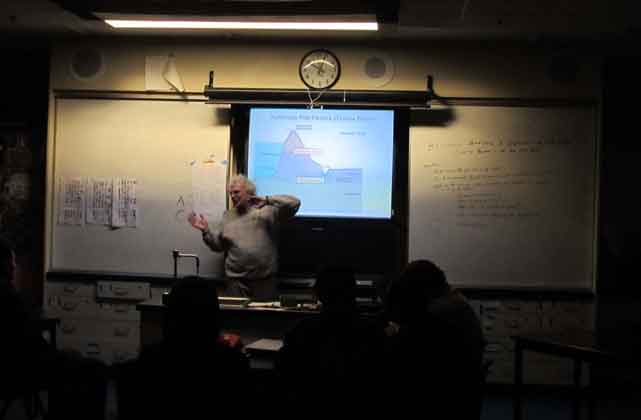
Below are some photos from the program. Sorry about the quality. Some rooms were dark because of slide show being shown. 
Roni Gehlke speaks on the subject of the Sacramento, San Joaquin Delta and the Rice Culture Mitigation Study (AFRI). 
This classroom worked with UC Davis grad students, including Emille Kirk and learn about rice growth and soil changes. 

This classroom worked with UC Davis grad students, including Emille Kirk and learn about rice growth and soil changes. 

Nicole Stern and Yumi Henneberry spoke on water quality in the Delta and the importance on the Study. 
Yumi Henneberry speaks on water quality.

This classroom learned about Delta issues and policy making.

This classroom learned about Delta issues and policy making.

Retired Freedom High School science teacher, Tom Lindumuth cam back to help out and present a program on important issues facing the Sacramento-San Joaquin Delta today. 

Retired Freedom High School science teacher, Tom Lindumuth cam back to help out and present a program on important issues facing the Sacramento-San Joaquin Delta today. 

Retired Freedom High School science teacher, Tom Lindumuth cam back to help out and present a program on important issues facing the Sacramento-San Joaquin Delta today. 

Science study discussed further.

Science study discussed further.

Science study discussed further.

DSC volunteers discuss the issue of what is subsidence?

DSC volunteers discuss the issue of what is subsidence?

UC Davis economics professor Leslie "Bees" Butler speaks on what economic changes to expect if farmers changed their crop to rice.

UC Davis economics professor Leslie "Bees" Butler speaks on what economic changes to expect if farmers changed their crop to rice.
Thanks to our Delta Science volunteers, science teachers, principal and vice principals at Freedom High School, UC Davis and UC Berkeley, Tetra Tech and all others who helped us during this event.