We've been behind on our posts this year. Attached you'll find our students' posts from this last few weeks.
June 17--
During this summer's program we are going to be making a few videos about the Delta. We aren't sure if we are going to get through all of them so we decided to concentrate on one video at a time. The first video is going to be on subsidence and the Delta levees.
Our plan is to make the videos no more than three to five minutes each, so we've been checking out short videos presented by other students who have done stuff like this before. We are also beginning to do the research involved in making the videos.
We're going to get to interview people from UC Davis and UC Berkeley that know about levees and subsidence in the next couple of weeks so we are setting up a list of questions for them.
June 24--
Today we watched a couple of more samples videos from students who won video awards for short videos. We also had the chance to do some research on levees so that we can come up with ideas how to make our video. We also took a tour of Big Break Regional Shoreline Park to check out the small levee system they have at the park. They have a really cool map on the ground that shows all the rivers that make up the Delta and it have a 3-D type of Mt. Diablo.
July 1--
Jersey Island Learning Lab-
Today we had the chance to see Jersey Island, which we learned is a good example of most of the Delta Islands along the Sacramento-San Joaquin River Delta. We saw the issues of subsidence. In some areas on the island the subsidence is as bad as 18th feet. We have a chance to walk along the levee and see the rock or what is known as "rip rap" that is holding the levees together.
We were able to take a lot of video and pictures to use in our video project.

Showing posts with label AFRI Science Days. Show all posts
Showing posts with label AFRI Science Days. Show all posts
Wednesday, July 8, 2015

Friday, August 30, 2013
Rice is flowering stage

Today we took air samples from our rice field AFRI project. We'll send the samples to our team at UC Davis who will check the totals. We take three carbon (gas) samples from each side of the field to see if there is any change to the amount of carbon emitted into air from each stage the rice is in. We take air samples every two weeks.

There are three main growth stages of the rice plant:

There are three main growth stages of the rice plant:
1. vegetative (germination to panicle initiation)
2. reproductive (panicle initiation to flowering)
3. ripening (flowering to mature grain)


Right now the rice on Jersey Island is at the flowering stage. The flowering stage begins with the emergence of the first anthers from the 'uppermost spikelets on each panicle.
Each individual spikelet flowers for only several hours during the middle of the day on two or three successive days.
Flowering begins among the uppermost spikelets and continues for approximately 15 days regardless of variety as the remaining spikelets successively open (the lowermost spikelets flowering last). During flowering, pollen from the anthers is transported by wind and insects to the stigma, which carry it down into the ovaries where fertilization of the ovules occurs.
In another week or so we will be draining the water from the field and letting the rice dry out which will take several weeks.


Saturday, June 22, 2013
Rice fields planted and our fields are ready for scientific study
Temperature: 63/95 degrees
Wind speeds: 5/15 mph
Better late than never as the story goes. Originally the plan was to transplant the rice from the nursery on May 15, however we experienced so many problems with wind and cool temps that we didn't get anything in the ground until today. No problem just 5 1/2 weeks late. Really it isn't any problem for us since harvesting rice isn't really our goal. As long as we have rice growing in the field to run the necessary tests over the next three to four months we're good to go.
Thanks so much to the people who came out today including UC Davis AFRI Grant volunteer Rongzhong Le, Freedom High School teachers John Sierra and Cheryl Ochinero (and her two children), Diane Burgis and their grew of Friends of Marsh Creek high school interns, Ironhouse Sanitary District's Doug Sheer, and community volunteers Glenn Gehlke, Christina Savatri and Joe Painter. As well as Dr. Mike Painter (president of the Delta Science Center) and Roni Gehlke (Executive Director of the Delta Science Center).
What a great crew and with everyone's help the job of transplanting took far less time than we originally thought. We were only able to fill one field with rice, but it is enough to start experiments. We are planning to put down some of the left over seeds into the second plot and see what happens. Right now we are soaking the seeds for a week.
Here are the photos from the event.


Wind speeds: 5/15 mph
Better late than never as the story goes. Originally the plan was to transplant the rice from the nursery on May 15, however we experienced so many problems with wind and cool temps that we didn't get anything in the ground until today. No problem just 5 1/2 weeks late. Really it isn't any problem for us since harvesting rice isn't really our goal. As long as we have rice growing in the field to run the necessary tests over the next three to four months we're good to go.
Thanks so much to the people who came out today including UC Davis AFRI Grant volunteer Rongzhong Le, Freedom High School teachers John Sierra and Cheryl Ochinero (and her two children), Diane Burgis and their grew of Friends of Marsh Creek high school interns, Ironhouse Sanitary District's Doug Sheer, and community volunteers Glenn Gehlke, Christina Savatri and Joe Painter. As well as Dr. Mike Painter (president of the Delta Science Center) and Roni Gehlke (Executive Director of the Delta Science Center).
What a great crew and with everyone's help the job of transplanting took far less time than we originally thought. We were only able to fill one field with rice, but it is enough to start experiments. We are planning to put down some of the left over seeds into the second plot and see what happens. Right now we are soaking the seeds for a week.
Here are the photos from the event.




Thursday, May 23, 2013
Freedom High School students come to site to learn about tests
May 9, 2013
Temperature: 51/73
Wind speed: 16/27 mph
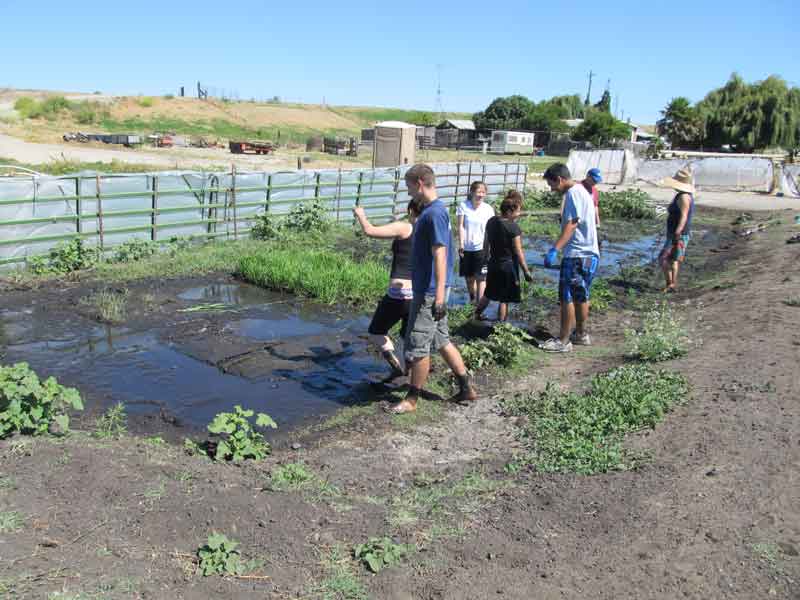
We were able to fit in a field trip before school ended this spring to the Jersey Island site. John Sierra and Cheryl Ochinero were the teachers involved in bringing out the students from the high school. Emille Kirk, Nicole Stern and Rongzhong Le came from UC Davis and Tetra Tech, UC Davis to help with the testing.
A week or so before the event I ordered all kinds of testing supplies from LaMotte Science Services so the student could do hands on testing.
Thanks to Nicole Stern from Tetra Tech, UC Davis in helping us order all the sets needed for the experiments.
Yumi Henneberry wasn't able to join us as she left on an extended trip. Hopefully she will be back toward the end of this year's planting season to see how far we've come on the project.
The students began by taking a tour up the hill to the levee and looked out to the San Joaquin River and then turned to look down onto the site where our rice fields are. This is a first hand look at subsidence and part of what our study is all about. I was also able to show them pictures taken in the 1920-30s, photographed from the same spot we were standing on. Instead of a hill that we now saw, there were level homes and at one time a hotel on the shoreline of the island.
Nicole Stern started the testing events by showing students how to test water samples. During the testing we were testing sulfates, nitrate/nitrogen, phosphates and ammonia-nitrogen.
Why do we test for sulfates in the soil?
Acid sulfate
soils are naturally occurring soils, sediments or organic substrates (e.g. peat) that are formed
under waterlogged conditions. These soils contain iron sulfide minerals
(predominantly as the mineral pyrite)
or their oxidation products. In an
undisturbed state below the water table, acid sulfate soils are benign. However
if the soils are drained, excavated or exposed to air by a lowering of the
water table, the sulfides react with oxygen to form sulfuric acid.
Why are we testing for nitrate nitrogen?
Nitrogen in the
soil is the most important element for plant development. It is required in
large amounts and must be added to the soil to avoid a deficiency. Nitrogen is
a major part of chlorophyll and the green color of plants. It is responsible
for lush, vigorous growth and the development of a dense, attractive lawn.
Although nitrogen is the most abundant element in our atmosphere, plants can't
use it until it is naturally processed in the soil, or added as fertilizer.
The availability
of nitrogen is often used to calculate the cost-to-benefit ratio of using
fertilizer in a given area.
When nitrogen
inputs to the soil system exceed crop needs, there is a possibility that
excessive amounts of nitrate (NO 3 - ) may enter either ground or surface
water.
Managing nitrogen
inputs to achieve a balance between profitable crop production and environmentally
tolerable levels of nitrates in water supplies should be every grower's goal.
Why do we test phosphate in water?
Phosphate’s role
in promoting plant growth actually makes it a dangerous pollutant when dumped
in excessive quantities into aquatic ecosystems. Plants have difficulty
obtaining phosphates. In fact, plants have so much difficulty that the
chemical is a limiting nutrient.
The rate at
which plants can grow and reproduce is limited by the amount of usable
phosphate in the soil or water. When humans add extra phosphorous to water,
they create a condition called eutrophication that can wipe out aquatic
ecosystems. Eutrophication is characterized by a rapid growth in the plant
population (an algal bloom).
With more living
plants comes more dead plants needing decomposition. The bacteria that
decompose the dead plants use oxygen, and eventually burn up so much that not
enough remains to support fish, insects, mussels, and other animals, leading to
a massive die-off.
Why do we test for ammonia-nitrogen?
Ammonia-nitrogen
is an inorganic, dissolved form of nitrogen that can be found in water and is
the preferred form for algae and plant growth. Ammonia is the most reduced
form of nitrogen and is found in water where dissolved oxygen is lacking. When
dissolved oxygen is readily available, bacteria quickly oxidize ammonia to
nitrate through a process known as nitrification.
Other types of
bacteria produce ammonia as they decompose dead plant and animal matter. Depending
on temperature and pH (a measurement of acidity), high levels of ammonia can be
toxic to aquatic life. High pH and warmer temperatures increase the
toxicity of a given ammonia concentration. High ammonia concentrations can
stimulate excessive aquatic production and indicate pollution.
Important
sources of ammonia to rivers can include: fertilizers, human and animal wastes,
and byproducts from industrial manufacturing processes. Techniques to prevent
high ammonia concentrations involve filtration of runoff water especially from
barnyards and other areas where animals may be kept in larger numbers, proper
septic system maintenance, and not over-fertilizing yards or fields.


Next Rongzhong Le spoke with the students about measuring carbon emission (greenhouse gas) within the rice field. The group took a pre-rice test to measure future emission tests from.
With the rice the peat soil, a natural carbon emitter into the atmosphere, soaked in water for the rice planting, the carbon emission will be considerable less.


Soil tests are completed to make sure that the rice isn't releasing substances into the soil that we don't want to be added. Whenever a change is made to the environment are can be unintended consequences. In the case of rise nitrates can change in the soil or methane gas can be added in the air. These will all be measured by the students to make sure if those changes are made they are within acceptable numbers.


Subscribe to:
Posts (Atom)